
Planning Fallacy, Priming, and a Surprising Gender Reveal
A #StudyStory and its Surprising Outcomes
By Deborah (Deb) Braidic, MABC, MSc
About #StudyStories: GAABS Members are permitted to share the story of their dissertation with our Editorial Board for review by using our Online Submission Form. Submissions are reviewed by our all-volunteer Editorial Board in alignment with GAABS publication guidelines.
THE BACKSTORY
Did you know that the most photographed building in the world—the Sydney Opera House—is smaller than originally planned, opened a decade later than anticipated AND had project overruns of 1,000%? No? Well it’s not alone. The Olympic Stadium in Montreal has a similar story—incurring costs 2,000% above forecast with the stadium dome alone outstripping the entire project budget and installation occurring 13 years after the games. And if you haven’t heard of Boston’s “Big Dig,” it’s worth a look—a project that took 9 years too long despite a project leg being abandoned and with budget overruns of 7x.
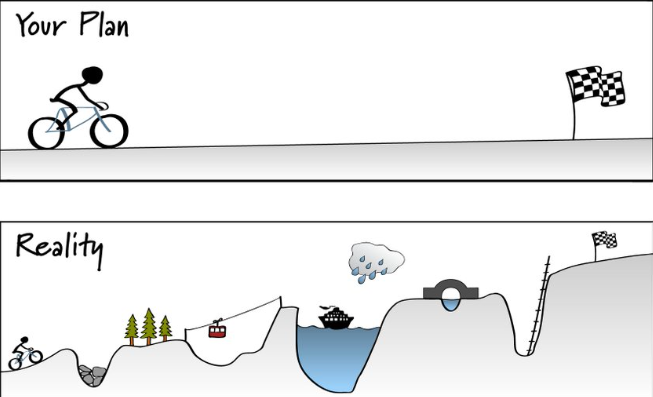
The common theme—all were taxpayer-backed projects, announced to great acclaim and anticipated to be wildly successful. Yet all fell prey to planning fallacy, a bias that comes from overconfidence accompanied by unreasonable optimism about our best-laid plans. Planning fallacy is like an invisible super-villain running around wrecking careers, kicking over budget coffers and rendering project managers virtually powerless to stop it. Science, despite valiant attempts, has yet to discover a silver bullet “drink this” antidote.
It’s a bias that is so powerful that, even when we look right at it, shaking our finger in its face, saying “No, planning fallacy! No!” it casually winks at us, says “Aren’t you adorable,” pumps out another best-case scenario labelled as “definitely, the worst case” and sends us packing. And in 2024, with the innocence that only a master’s student might have, I read about planning fallacy and thought, “Fun! Let’s see if I can use behavioural science to help.”
THE SETUP
For my master’s dissertation (capstone for those in the states), I focused on the corporate environment and used manager-employee interaction as the context. My question was: Can managers effectively prime their team members against planning fallacy?
Now, priming is tricky. You have to present information in a particular way that the human brain can absorb without realizing it right before they complete their next task. It’s difficult to pull off, but upon interrogation, priming is what good managers do in real life—every single day. Their secret power is using every trick they know to aid and abet their fellow humans to success in the workplace in support of organizational goals and often, they rely on priming without realizing it.
THE INTERVENTION
I set out to run an experiment on prolific testing two primes against a control group.
Control Group
Participants (359) read a 30-second vignette in which their supervisor emails at 8:30 a.m. and asks for a project plan to be sent by end of day, explaining that they need to review the information ahead of a leadership meeting the next morning. Participants were then asked: 1) how long they forecasted the work would take, 2) what time they would begin, and 3) how motivated they were to complete the task.
Condition 1 (Intervention Group 1)
This vignette used an emotional prime of caution, indicating that previous timelines had received leadership pushback without specific direction.
Condition 2 (Intervention Group 2)
This vignette primed participants to unpack the task—reminding them of things like, “you’ll need to find the planning template, input the context, add historic timelines,” etc.
THE RESULTS
The emotional prime (Condition 1) DID NOT work (good to know that emotional leverage has little impact here).
The (Condition 2) unpacking prime worked. Merely alluding to “you’re going to have to do A, B, and C to get that work done,” created more conservative forecasts without diminishing motivation—also good to know (in the table below, “higher” is better as it indicates a more conservative estimate).

THE SURPRISE
But here was the surprise – and it involves a gender reveal. One gender significantly outperformed the other in conservative forecasts.
Can you guess which?
Well … let’s just say that, if you want time forecasts that are more resilient to the impact of planning fallacy, you will want more women on the team. In every group, women forecasted 28-30 additional minutes to complete the task than their male counterparts. Interesting, no? Could it be that women have a bit of a natural antidote against planning fallacy?
TAKE-AWAYS AND CALLS TO ACTION
The first take-away is that, for managers and leaders, helping your team members unpack their planning efforts is an easy way to get to a more conservative forecast. It’s simple, easy, concrete and easy to implement today, if not tomorrow.
My second take-away is a call to action … fellow behavioural scientists, should we look into this? Does the gender difference I observed stand up to scrutiny? Are female brains naturally better at forecasting? Given how damaging that the supervillain of planning fallacy can be, I think we’ve got to give it every shot we can.
*This post was edited on March 7, 2026 to address incorrect labeling of the Intervention Groups.