
From "Made in China" to Market Leader: How Chinese Carmakers Out-Engineered a Nation's Biases
Why the winning move wasn't building a better car; it was building a smaller worst case
By Adam Gottlich - Behavioural Science | Consumer Decision-Making
Picture a South African family standing in a car dealership in 2022, looking at a Chinese-branded SUV. It's cheaper than the Toyota next to it and has a nicer screen. And yet something in the back of their mind says no. Not a thought, exactly - a flinch. "Made in China." Cheap. Won't last. Worthless in three years.
That flinch was, until very recently, the single biggest obstacle in the South African car market. In a global survey, 42% of buyers named China their least preferred place for a car to come from - 25 points clear of the next-worst country. This isn't a small penalty. It's a tax applied at the till that no competitor had to pay.
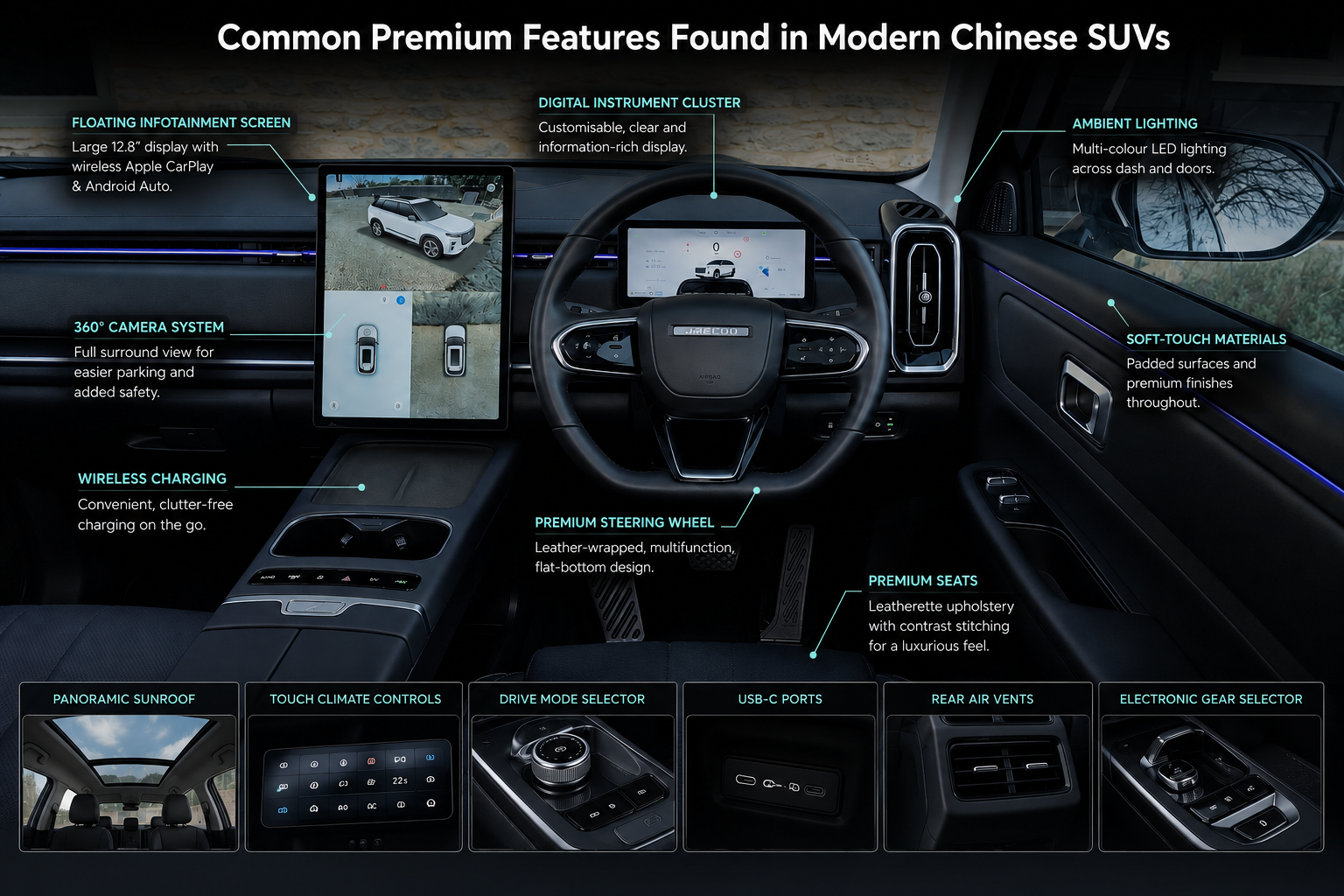
Common Chinese SUV Features - Image: Adapted from manufacturer imagery.
They shrank the worst case instead of inflating the best
Most marketing tries to make you dream bigger. Chinese carmakers did the opposite. They understood, whether they'd read Kahneman and Tversky or not, that losses loom about twice as large as equivalent gains. A nervous buyer isn't fantasising about how good the car might be; they're catastrophising about the breakdown, the unobtainable part, the resale collapse.
So Chery didn't lead with joy. It led with a 10-year, 1,000,000 km engine warranty and its South African CEO said out loud that the point was to "rebuild customer trust and prove product reliability." That is signalling theory in its purest form. Honouring a million-kilometre warranty on a bad engine would be financial suicide, so the act of offering it is credible precisely because it would be too expensive to fake. The brand isn't saying "trust us." It's saying "watch where we put our own money." GWM went further and made its 7-year warranty transferable - a direct play on residual-value anxiety, quietly underwriting its own used-car prices.
Loss aversion says: cap the downside, and the fearful buyer will move. So they capped it.
The screen was an alibi for everything you couldn't check
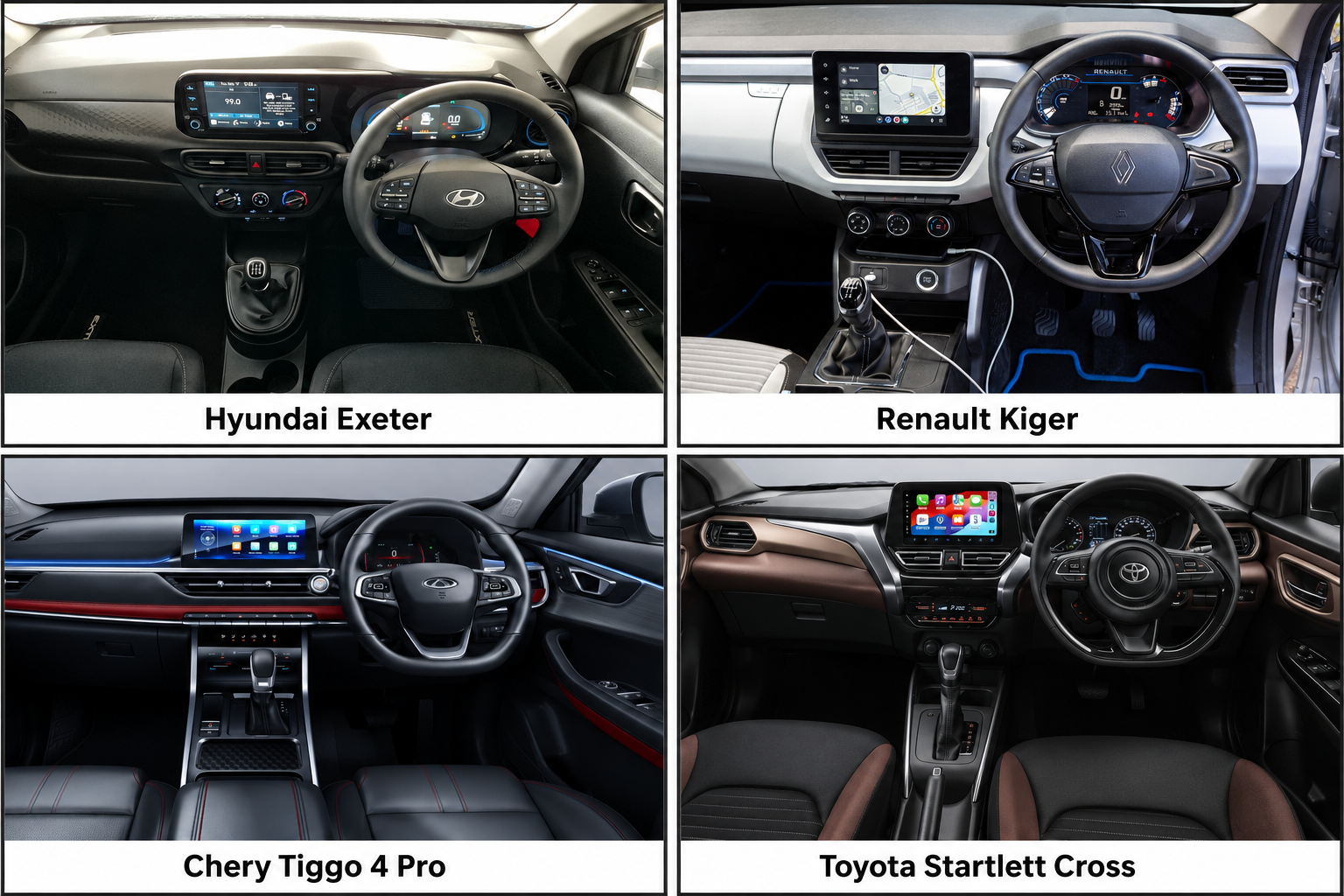
You cannot assess weld integrity or corrosion resistance on a test drive. But you can tell whether the touchscreen lags. Chinese cabins are engineered around this fact.
This is attribute substitution at work. Faced with a hard, unanswerable question of "is this car well-built and reliable?" - the mind quietly swaps in an easy one it can answer: "does this interior feel impressive?" It then reports the answer to the easy question as if it had answered the hard one. A crisp 15-inch display, ambient lighting, soft-touch materials: these are high-fluency cues that the brain reads as "modern," then silently generalises into "well-made." The screen becomes a stand-in for all the quality signals a buyer can't verify - the perfect alibi.
Pair that with an aggressive price (the Chery Tiggo 4 Pro lands from R269,900 with an interior that looks like it belongs at double the money) and you get anchoring. The low price doesn't just undercut rivals; it resets what the buyer believes a feature-rich car should cost, leaving legacy brands looking overpriced without them changing a thing.
Image: Adapted from manufacturer imagery.
When the fortieth car is just a car
The first Chinese car on your street is a gamble. The fortieth is wallpaper.
This is social proof, and it's sharpest exactly when people are uncertain - which is the definition of a stigmatised, unfamiliar brand. Every additional Chery, Omoda, Jaecoo, GWM, Jetour and BYD on the road, every neighbour who shrugs and says "it's been fine," is evidence that costs the manufacturer nothing and compounds automatically. Add mere exposure (we like what we see often) and a design that was "suspiciously unfamiliar" in 2021 becomes "normal" by 2026 without a single new argument being made.
And then the cleverest turn of all: the identity on offer changed. Buying Chinese used to mean "I couldn't afford better." Now it means "I'm a savvy, tech-literate person who saw through the badge markup." That's not a defensive identity, it's an aspirational one that buyers are happy to wear. The stigma didn't just fade, it got rebranded as smart.
The takeaway for behavioural scientists
We spend a lot of energy trying to make people want things more. This case is a reminder that the faster route is often to make them fear the downside less. Chinese carmakers didn't win a beauty contest against heritage brands. Instead, they ran a systematic risk-reduction campaign, dismantling one bias at a time: loss aversion with warranties, quality uncertainty with fluent design cues, reference points with price anchors, and unfamiliarity with sheer social proof.
The strategic lesson is uncomfortable for incumbents and useful for the rest of us: you cannot out-heritage a reference-point shift. Once the public's definition of "normal" quietly moves, nostalgia for a badge won't move it back. Beliefs that feel immovable (even one held by 42% of a market) are often just under-attacked. Find the specific fear underneath the flinch, make its worst case smaller, and the behaviour follows.
The flinch, it turns out, was never made of steel. It was made of assumptions, and assumptions can be engineered.
Resources
For readers who'd like to explore the mechanisms behind this article:
Kahneman, D. & Tversky, A. (1979).Prospect Theory: An Analysis of Decision under Risk. Econometrica. — The foundation for loss aversion.
Spence, M. (1973).Job Market Signaling. Quarterly Journal of Economics. — Why a costly, hard-to-fake signal (like a long warranty) is believable.
Akerlof, G. (1970).The Market for "Lemons". Quarterly Journal of Economics. — Quality uncertainty and how buyers respond to it.
Kahneman, D. & Frederick, S. (2002).Representativeness Revisited: Attribute Substitution in Intuitive Judgment. In Gilovich, Griffin & Kahneman (Eds.), Heuristics and Biases: The Psychology of Intuitive Judgment (pp. 49–81). Cambridge University Press. — Swapping a hard question for an easy one.Reber, R., Schwarz, N. & Winkielman, P. (2004).Processing Fluency and Aesthetic Pleasure. PSPR. — Why "easy to process" feels like "high quality."
Cialdini, R. (1984).Influence: The Psychology of Persuasion. — Social proof under uncertainty.
NielsenIQ (2023).Turning the Wheel: China's Bold Inroads into European and Global Automotive. — Source of the 42% "least-preferred country of origin" figure.
naamsa / Reuters (2026). South African new-vehicle sales data — Chinese passenger share 16.8% (2025) vs 11.2% (2024); the "structural reset" framing.
About the Author
Adam Gottlich is the founder of Nudge Labs and an award-winning behavioural scientist specialising in applied behavioural science, experimentation, and behaviour change. He has spent more than a decade helping organisations translate behavioural research into measurable commercial and customer outcomes. Connect with Adam on LinkedIn
For more information about GAABS, please visit GAABS.org and follow us on LinkedIn.
Questions about becoming a member of GAABS? Contact members@gaabs.org.