
From the “Hand of God” to the Video Assistant Referee
Why better decisions don't always lead to more trust
By Majd Abdo MSc. Behavioral Economics | Decision Environments | Organizational Design
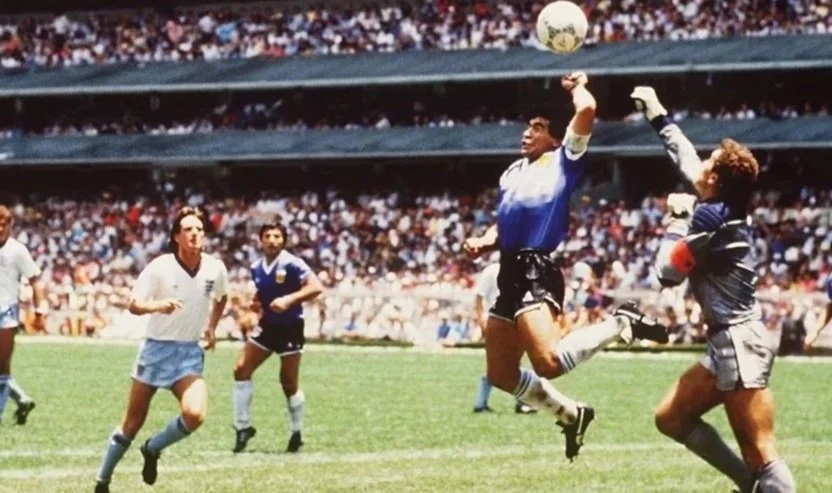
In the 1986 FIFA World Cup quarter-final between Argentina and England, one of the most famous moments in football history took place.
Six minutes into the second half, Diego Maradona jumped for the ball alongside goalkeeper Peter Shilton and scored. The goal was awarded, despite television replays clearly showing that Maradona had used his hand.
Years later, Maradona described the moment with a smile:
"A little with the head of Maradona, and a little with the hand of God."
The incident became known as the "Hand of God" goal and remains one of the most debated moments in sport.
What fascinates me about this story is not football itself. It is what the incident reveals about human behaviour, dishonesty, and our understanding of fairness.
Diego Maradona, 1986
Why Small Acts of Dishonesty Feel Acceptable
Behavioural economist Dan Ariely explored this question in his book The Honest Truth About Dishonesty. His research suggests that most people do not behave as completely honest or completely dishonest individuals. Instead, many of us operate within a grey area. We cheat a little, bend rules slightly, or justify questionable actions while still maintaining a positive image of ourselves.
The goal is not simply to gain an advantage. The goal is to gain an advantage without feeling dishonest.
Maradona's famous quote captures this tension perfectly:
"A little with the hand of Maradona..."
Not a major violation. Just a small one—at least from his perspective.
The incident reminds us that dishonesty is often not a battle between right and wrong. It is a negotiation between personal benefit and self-image.
Football's Technological Solution

For decades, football relied almost entirely on human judgement. Referees made decisions in real time, under pressure, often with incomplete information.
As the sport became faster and more valuable, mistakes became harder to accept. The solution seemed obvious: introduce technology.
In 2018, VAR (Video Assistant Referee) was introduced at the FIFA World Cup with the goal of reducing major refereeing errors. The logic was simple:
More information should lead to better decisions.
Better decisions should lead to greater trust.
Yet something unexpected happened. Although VAR improved accuracy, controversy did not disappear. In many cases, arguments became even more intense.
Why?
Image Credit: Fifa
Accuracy and Trust Are Not the Same Thing
The common assumption is that people trust systems when they produce accurate outcomes. Behavioural research suggests the relationship is more complicated.
People care about outcomes, but they also care about processes.
Psychologists refer to this as procedural justice: the idea that people are more likely to accept decisions when they believe the process behind them is fair, transparent, and understandable.
This helps explain an interesting paradox. A referee making an incorrect decision in real time may be forgiven because the limitation is visible. A VAR decision, however, is expected to be objective. When fans do not understand how a decision was reached, frustration often shifts from the outcome to the process itself.
The question becomes:
"How did they reach that conclusion?"
Rather than:
"Did they make a mistake?"
The New Challenge: Trusting Systems We Cannot Fully See
Football may be one of the clearest examples of a challenge that extends far beyond sport.
Today, decisions are increasingly supported by algorithms, automated systems, and artificial intelligence. Credit approvals, hiring recommendations, medical assessments, and public services all rely on systems that many people interact with but few fully understand.
In theory, these technologies can improve consistency and accuracy. In practice, accuracy alone may not be enough.
People also want visibility into the process. They want to know how decisions are made, who is responsible, and whether the rules are being applied fairly.
In other words, trust requires more than being right. Trust requires being understood.
Could VAR Have Missed the Hand of God?
Technically, probably not. The handball itself would likely have been detected.
But the broader lesson remains relevant. Football solved one problem—detecting errors—only to discover another: maintaining trust in the decision-making process.
The challenge was never only about seeing more. It was about helping people understand what they were seeing.
And that may be one of the most important behavioural questions of our time.
As Professor Richard Thaler reminds us, the more complex the decision, the more help people need to understand how it was made.
Resources
For readers who want to explore the ideas behind this article:
• Ariely, Dan. The Honest Truth About Dishonesty (2012). A behavioural economics perspective on why people cheat, justify small violations, and still see themselves as honest.
• Tyler, Tom R. Why People Obey the Law (1990). A foundational work on procedural justice and why people accept decisions when they believe the process is fair.
• Tyler, Tom R. Procedural Justice and the Courts (2007). A useful extension of procedural justice theory into institutional decision-making and legitimacy.
• IFAB (International Football Association Board) – VAR Protocol. The official framework explaining how VAR is intended to operate in football.
• FIFA – VAR and the Laws of the Game. Background material on the introduction and use of VAR in international football.
• Kahneman, Daniel. Thinking, Fast and Slow (2011). Helpful for understanding how people evaluate fairness, uncertainty, and decisions under pressure.
For more information about GAABS, please visit GAABS.org and follow us on LinkedIn.
Questions about becoming a member of GAABS? Contact members@gaabs.org.