
The Genius Myth: the Masterclass in cognitive bias we didn't know we needed
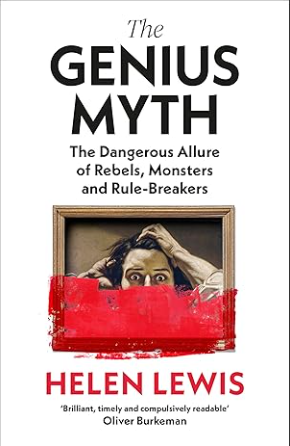
The Genius Myth: The Dangerous Allure of Rebels, Monsters and Rule-Breakers
If you haven’t recently read a book that made you stop and shout “OMG, yes!” to a (usually) empty room, I recommend getting Helen Lewis’ “The Genius Myth” and sitting down for a few hours to take it in. It articulates something I've always felt but somehow struggled to put into my own words. The big take-away is that our societal belief in the concept of a genius is “a dangerous idea.” Curious? Read on to find out more.
You may be wondering why, given that this is a GAABS blog, I am reviewing a book that is ostensibly not about behavioural science. The answer is that, the more the author points out all the faulty logic we use in the construction of the so-called genius myth, the more this book reads like an accidental checklist of well-documented heuristics. "Wait..." I thought, about halfway through, as more and more of them appeared. "Is the genius myth actually a collection of biases in a trench coat?"
It’s interesting how committed we are to constructing and sustaining the idea of the lone, transcendent visionary whose brilliance arrives fully formed, defies convention, and reshapes the world. But "genius", the author argues, is less of an objective, biological fact and more of a social label. It’s a kind of secular sainthood we bestow on individuals to satisfy our deep hunger for simple, heroic stories (Narrative Bias, anyone…?).
Here’s a brief summary of four of the biases I spotted (among others) in the book:
1. The Fundamental Attribution Error: Ignoring the "Scenius"
The core of the genius myth seems to be a standard case of the Fundamental Attribution Error. This is the idea that we have a persistent tendency to overemphasise personality traits - the "innate brilliance" - and underestimate situational factors: the environment, the timing, the "scenius."
Lewis highlights how we celebrate the solitary inventor while wilfully ignoring the invisible battalion of wives, assistants, and collaborators who provided the emotional and logistical scaffolding for their work.
From a behavioural perspective, the genius myth is a strategy to reduce the cognitive load of a complex, multi-causal world into a single heroic protagonist. It is tidier that way, and easier to digest...but what's left is, at best, a distortion.
2. The Halo Effect: Genius as Moral Licence
Why do we tolerate "monstrous" behaviour from high-achievers? Behavioural science points to the Halo Effect. When we perceive someone as possessing an extraordinary positive trait, our brains lazily generalise that positivity to their entire character (helped in no small way by Confirmation Bias). Or worse: we use their genius as a form of moral licence, a permission slip to overlook what we would never overlook in anyone else.
Lewis explores how the label of genius acts as a shield, allowing individuals to bypass social norms and ethical standards. In a well-designed organisation, we would call this a failure of accountability systems. Thanks to the genius myth, we often excuse it in individuals, calling it "eccentricity" (and then writing admiring biographies about it).
3. The Availability Heuristic: The Seduction of the "Aha!" Moment
We love the story of Newton's apple and Archimedes' bathtub because these moments are mentally available - vivid, singular, and easy for our brains to retrieve. The reality of innovation - years of incremental, often tedious, frequently failed experimentation - is far harder to hold in the mind - not to mention far less satisfying to retell!
The truth is, figures like Thomas Edison were as much masters of mythmaking as of invention - carefully engineering their own legends, emphasising the story of the ‘spark’ while obscuring the long, expensive (not to mention boring) burn. The availability of the dramatic moment crowds out the truth of the process. We remember the apple….but forget the orchard.
4. Hindsight Bias and Survivorship: Making the Impossible Look Inevitable
Finally, the book is full of what behavioural scientists will recognise as Hindsight Bias - and its close companion, Survivorship Bias. Looking back at history, we treat the success of a genius as if it were a mathematical certainty. Their path appears as a straight line from vision to victory - alas, the role of luck, timing, and sheer contingency is edited out in post-production.
What does this mean?
Our brains, discomfited by chaos and chance, are only too happy to retroactively construct a narrative of destiny to make sense of it all. We are, in this sense, not just consumers of the genius myth - we're also its enthusiastic co-authors. Oh dear.
What is closer to the truth is that many so-called geniuses were simply the ones still standing when the dust settled - the survivors of processes far messier and more random than the legends suggest.
If you are curious to find out more, be sure to read the book; it covers some fascinating examples, including stories about Edison, Picasso, Shakespeare, the Beatles, Tolstoy and the Wright Brothers (among others).
Why This Matters
Ultimately, Lewis doesn't ask us to stop admiring great achievements, but she does advocate that we stop falling for the lone-wolf narrative. Her proposed solution is a shift in how we credit success: moving away from the fragile "Genius" model and toward an appreciation for the "Scenius" - the collective, often invisible, ecology of talent and labor that makes a breakthrough possible.
In her view, we must stop using the label of genius as a moral license for "monstrous" behavior and start valuing the incremental, the collaborative, and the messy reality of human progress.
She might call it recontextualising; we might call it choice architecture. By consciously redesigning our cultural and organisational "defaults" to recognise the environment over the individual, we could move away from a cult of ego and personality and toward a more useful, honest, and inclusive understanding of how the world actually changes. Who knows what progress humankind could make if we were able to master this.
Author profile
Shelley Hoppe is Chair of the GAABS Editorial Board, Founder of the BEHAVES Academy — an applied behavioural science training programme — and of SBC, a behavioural learning and communications consultancy. Shelley and her team work with leaders to identify and solve the specific behaviour problems that generic training consistently fails to fix: influencing campaigns that need to actually shift behaviour, compliance programmes that keep stalling, and onboarding processes that nobody follows consistently. Her work spans instructional and communications design, and the application of behavioural science to real organisational challenges.