
Improving Decision Quality in Co-Design Workshops
By Rachel A. Wood, MSC, GMBPsS, Editorial Board Member, Certified Individual Member
Researcher in Service Co-design, Open University, UK
When people hear ‘co-design,’ they sometimes picture a friendly workshop and a wall of sticky notes. That can be part of it, but co-design is more specific, it’s a structured way of making decisions about services with the people who use and run them. The promise is better ideas grounded in real experience. The challenge is that group dynamics can quietly distort what the group ‘decides,’ which is why how we facilitate co-design matters as much as who is in the room.
It can produce better services, but only if the workshop avoids an ‘echo chamber,’ where the same views get repeated, quieter perspectives drop out, and early opinions set the direction. This blog sets out some suggestions to break that pattern, so groups can think more clearly, disagree safely, and make better decisions together.
Co-design is a way of designing services with the people who will use and deliver them. That often means bringing service beneficiaries, practitioners, and commissioners into the same room to make sense of needs, test ideas, and try out early versions of solutions. The opportunity is getting closer to what matters in real life. The risk is that group dynamics can produce false consensus, scattered priorities, or polite agreement that hides real disagreement, all of which can keep the group in an echo chamber.
Breaking the Echo Chamber
Design for independence first: get individual views before group discussion.
Make thinking visible: externalise ideas (notes, maps, prototypes) so contradictions can be worked with.
Use questions, not persuasion: adopt a facilitative stance that surfaces assumptions.
Balance strengths and problems: use strengths-based enquiry to reduce defensiveness while still testing feasibility.
Key Concepts in Co-Design
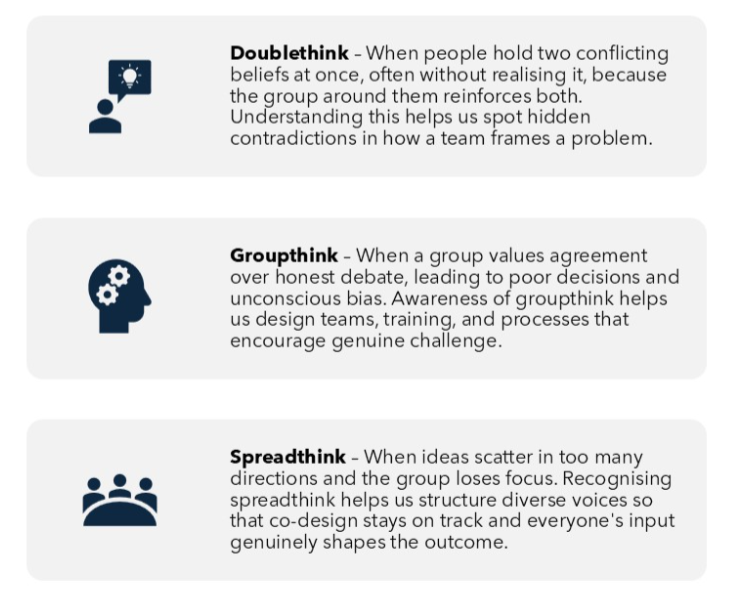
Groupthink: prevent the loudest voice becoming the ‘truth’
Groupthink happens when the desire for harmony (or speed) pushes a group to suppress dissent and settle on a weak decision. In workshops, a common trigger is the first confident contribution. It can anchor the discussion and everyone else adjusts around it.
Practical facilitation moves:
Start silently (2–5 minutes): ask everyone to write or sketch their answer to the same question before anyone speaks.
Hear from everyone once: go round the group and take one idea per person before opening up discussion. Allow people to pass.
Sort ideas, then do a quick vote (dot voting): put ideas on a wall/board, group similar ones together, then let each person place 3 stickers (or marks) next to the ideas they think matter most. Count the stickers to see what the group prioritises, without debating first.
Ask what could be missed: explicitly ask, ‘What might not work about this?’ and ‘Who might be negatively affected or left out?’
Socratic dialogue: use questions to surface assumptions (without leading)
Socratic dialogue is an intentional way of asking open, non-leading questions so participants examine the rules behind their thinking. It can be a ‘leveller’ in mixed groups because it shifts status from who speaks best to how well we can justify and test an idea.
For behavioural scientists, it is a practical method that can be used for eliciting assumptions (about capability, opportunity, motivation, norms, risk, stigma, and so on) before you rush to solutions.
Clarify: ‘What do we mean by…?’ ‘Can you give a recent example?’
Probe assumptions: “What are we taking for granted?” “Who is this
designed for—and who is missing?”
Test evidence: ‘What makes us confident?’ ‘What data would change our mind?’
Explore alternatives: ‘What else could explain this?’ ‘What’s the opposite approach?’
Check consequences: ‘If we implement this, what could go wrong in week one?’
Strengths-based enquiry (Appreciative Inquiry): reduce defensiveness and widens participation.
Appreciative Inquiry is a strengths-based approach, you start with ‘what’s working’ and build from there. In co-design this is useful, because problem-talk can quickly turn into blame, especially when people hold different roles (e.g., service beneficiaries, practitioners, commissioners). A strengths-first sequence often creates psychological safety, which in turn improves the quality of what people are willing to share.
Strengths-based prompts for the next workshop
‘Tell us about a time this service (or something like it) worked well, what made that possible?’
‘What strengths do beneficiaries and practitioners already bring that we can design around?’
‘If we scaled the ‘best bits,’ what would we protect at all costs?’
‘What would ‘good’ look like in everyday language?’
Then pivot to realism: “What might stop this working, and how could we design around that?”
When groups stall or ‘agree politely’: Spreadthink and doublethink.
Spreadthink is when a diverse group generates lots of perspectives but can’t converge on priorities, everything feels important, so nothing moves. In complex services this is common and not a failure; it’s a signal you need more structure.
Cluster first: group ideas into themes (silent clustering works well).
Name the decision: are you agreeing priorities, testing hypotheses, or choosing a prototype?
Use a constraint: ‘If we can only do two things in 8 weeks, what are they?’
Make criteria explicit: impact, feasibility, equity, acceptability (pick 2–3).
Doublethink (in organisational life) is when people hold contradictory views but don’t
name the contradiction, often because it feels risky. In workshops it looks like, people
nod, but later you hear, ‘I’m not sure that will work.’ Co-design can reduce this by
making tensions visible and workable.
Use ‘both/and’ prototypes: when you hear opposites (e.g., ‘more structure’ vs ‘more flexibility’), prototype two variants or a hybrid and test them.
Implementation reality check: identify what might make this hard to deliver in practice (barriers, capacity, equity, safety) and what support would make it workable.
Private check-out: end with an anonymous prompt: ‘What did we avoid saying today?’
In Conclusion
Breaking the ‘echo chamber’ is mostly about how the conversation is run. Start by getting everyone’s views before discussion (a short silent start works well). Then use a few open questions to check what assumptions sit behind the ideas. Finally, agree on the decision being made and choose priorities using simple criteria (for example - impact, feasibility, and fairness), then test the top ideas with a quick prototype. When people can contribute safely and differences are made visible, co-design is more likely to lead to clear, workable decisions, not just that room full of opinions.