
By Deborah Braidic, MABC, MSc, GAABS Director and GAABS Editorial Board Member
A decade on, Grit, by Angela Duckworth, PhD, still reads like a generous conversation with a curious, self-questioning researcher. With our GAABS interview with Dr. Duckworth about her new book, Situated, only a few weeks away, I went back to the book that made her name. I wanted to reacquaint myself with her story and her style, and to re-read it through a practitioner's eyes.
What struck me most second time round is how consistently she turns what most people would say is a character trait (i.e. you either have it or you don’t) into things people can actually do—behaviours in which you can actively engage. For a behavioural science practitioner, that is the book's quiet strength and it made me smile to read it all over again.
Effort counts twice
Duckworth's central argument rests on two simple equations: talent × effort = skill, and skill × effort = achievement. Effort appears twice; talent only once.
The behavioural appeal is clear. Talent is difficult to change, but effort is a behaviour, and behaviour can be shaped. By locating so much of achievement in what people repeatedly do, she shifts the question from the things that the luck of the gene pool drew for you, to what someone does and how much effort they plow into their work.
From trait to practice
The middle of the book, on growing grit "from the inside out", is where her recommendations become most concretely behavioural. A few stand out as worth sharing with my fellow practitioners:
Deliberate practice. Drawing on Anders Ericsson's work, she breaks expert improvement into observable components: a clearly defined stretch goal, full concentration, immediate and informative feedback, and repetition with reflection.
Habit and context. Experts tend to practise at the same time and in the same place each day. Routine removes the daily decision about whether to begin, which is often where effort leaks away.
Goal hierarchies. Lower-level goals must ladder up to a higher-level goal or be carefully weeded out of the goal list. I must admit, this is a toughie for me. I love having lots of goals and letting myself pursue every interest with gusto. I have gotten better about setting time limits to these pursuits and reassessing, but I know that I give myself too much latitude here.
Hope as perceived control. Her treatment of learned helplessness, drawing on Martin Seligman's research, frames persistence as something that depends on believing one's actions matter.
None of this asks readers simply to try harder. It asks them to set up the conditions in which trying harder becomes the easier path.
Parenting for grit: a behavioural design brief
I am not a parent, but as a child who often complied with parental requirements while silently wondering whether they knew what they were doing, I found this to be one of the most valuable parts of the book.
First, I appreciate how Dr. Duckworth helps the reader understand when it is best to let other adults teach your child grit and when you should take the lead role. Also, she argues for parenting that is both supportive while also being demanding—high standards held with warmth. The same pairing would serve any manager, coach, supervisor or mentor.
She also shares the Duckworth family’s “hard thing rule.” In her family every person takes on something hard that requires daily deliberate practice. You agree to take it on for a fixed period of time, say a year. And other than that natural stopping point of the year, you may not quit, even when facing a bad day or bad week. You choose your hard thing; no one else does it for you. The approach integrates several commendable behavioural elements:
A commitment device with a built-in exit. Deciding in advance when quitting is permitted prevents arbitrary relinquishment of striving.
Autonomy. Letting each person choose their own hard thing protects intrinsic motivation and ownership.
Modelling. Parents follow the rule too.
A social norm. Doing hard things becomes simply what this family does.
She supports the rule with research showing that sustained participation in extracurricular activities, rather than dabbling, is associated with better outcomes. The rule is small, clear and easy to follow, which is precisely why it works as an intervention.
A few take-aways for you
Three things are worth carrying into your own work—perhaps you’re already doing so:
Look for the behaviour and design for it.
Pair high expectations with genuine support; neither works well alone.
Agree on the rules for stopping before difficulty begins.
Looking ahead to Situated
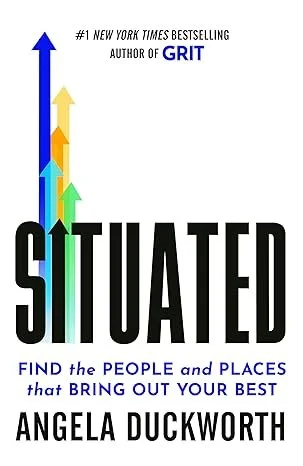
Rereading Grit now, it is hard not to notice how often its best advice is really about the situation: the routine, the household rule, the coach who is both warm and exacting.
During GAABS’ webinar with Dr. Duckworth on December 16 (hint, hint to register), I am looking forward to asking how her thinking has developed since, and what the title of her new book signals about where she now places the emphasis.